Computer Vision.
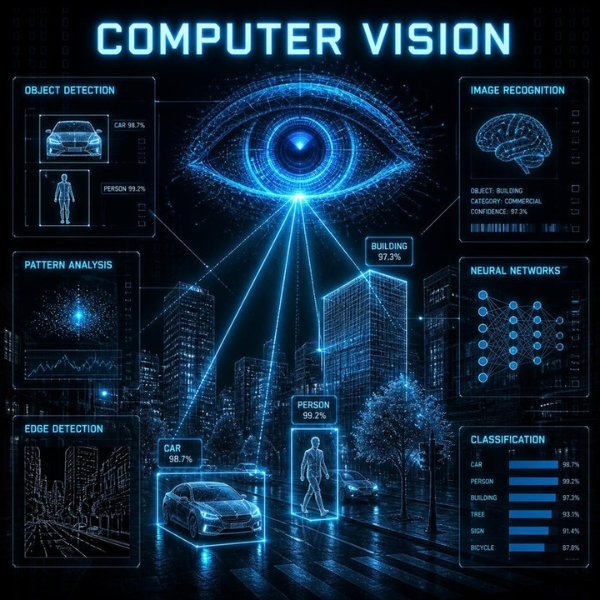
Computer vision is a field of artificial intelligence focused on training computers to interpret and understand visual information from images and video, enabling them to identify objects, faces, scenes, and patterns in much the way a human eye and brain would.
Computer vision systems typically rely on convolutional neural networks and other deep learning architectures, trained on large labeled image datasets, to recognize patterns such as edges, textures, and shapes, then combine these into higher-level understanding like object detection, image classification, and facial recognition. Beyond static images, computer vision also covers video analysis tasks such as motion tracking and action recognition. The field powers a wide range of applications, from autonomous vehicles reading road signs and pedestrians, to medical imaging tools that flag anomalies in scans, to retail systems that track inventory on shelves. As one of the most important perception modalities underlying much of today's physical AI and robotics work, computer vision is a key part of what allows a machine to perceive its surroundings well enough to act on them, typically alongside other sensing methods such as lidar or tactile sensing.