Deep Learning.
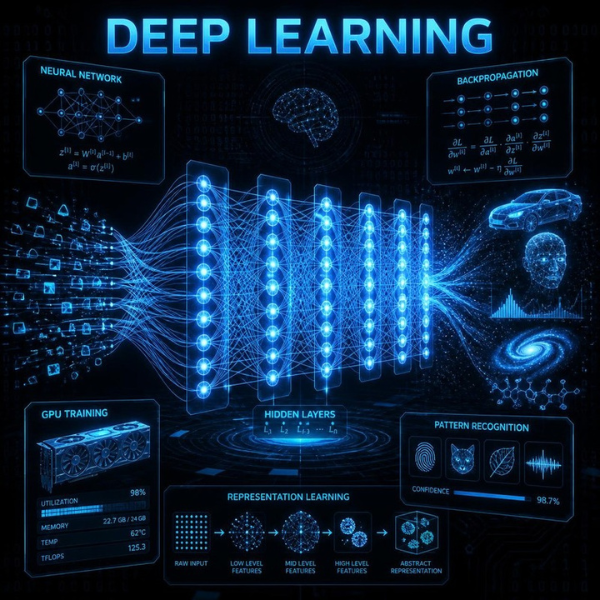
Deep learning is a subset of machine learning that uses artificial neural networks with many layers to automatically learn patterns and representations directly from large amounts of data, without requiring manually engineered features.
Each layer in a deep neural network learns to recognize increasingly abstract patterns, starting from simple features like edges or word fragments in early layers and building up to complex concepts like objects or meaning in later ones. Training relies on backpropagation, an algorithm that adjusts the connections between artificial neurons based on how far the network's output was from the correct answer, repeated over large datasets and, in practice, powered by specialized processors such as GPUs. Deep learning underpins most of the AI capabilities in wide use today, from the large language models behind chatbots to the computer vision systems used in image recognition and self-driving cars. Its rise since the early 2010s was driven by three factors converging at once: much larger datasets, far more powerful and affordable computing hardware, and refinements to the neural network architectures and training techniques themselves.